
When a team considers putting an agent on its ticket queue, the conversation always comes down to how much the agent may do without asking. Letting it answer clients by itself from day one is where the time savings are. Refusing to let it send anything a person hasn’t read is where the trust is. A team usually needs the second before it’ll accept the first. We’re building TRUE Agents into TrueTicket, our ticketing platform. The design we’ve settled on treats autonomy as a setting a team grants, per category and per ticket, rather than as a property of the agent.
TrueTicket’s agents will have three operating states. In Manual, the agent only acts when someone mentions it on a ticket. Even then it doesn’t take control: it answers with an internal note, while anything it wants to change becomes a suggestion for the operator who asked. Suggest has it draft replies and actions that an operator approves or rejects. Autopilot lets it work tickets on its own within the scope it was given, handing them back when it should. Each category has a default state that every new ticket starts in. An operator can switch a single sensitive ticket to Manual without touching the category or any other ticket. The feature is still in development and will open first as early access, so this post is about the reasoning more than the release.
The agent shouldn’t know which mode it’s in
The most important decision is one users will never see. Suggest and Autopilot run exactly the same agent with the same prompt and the same tools. Every write the agent wants to make, whether it’s a reply to the client, an internal note, a status change or a reassignment, stops at an approval gate. In Suggest an operator answers that gate. In Autopilot, TrueTicket answers it, approving the write only when the capability was granted and the ticket is still in Autopilot, with the category inside its limits.
We looked at the alternatives and didn’t like them. Two builds of the agent (or two prompt modes) would mean that graduating a category changes how the agent behaves, which defeats the purpose of watching it in Suggest first. Letting the agent read its mode and decide whether to ask is technically easy, since a tool can decide at runtime whether it needs confirmation. The problem is that enforcement would then live inside the agent, where a prompt bug could skip it. We’d rather keep the decision about what the agent may do somewhere the model can’t reach.
That’s also why there’s a second gate. When a write reaches TrueTicket’s API, a policy for a new AGENT role checks it again. That policy allows reading plus the permissions behind the granted capabilities. It refuses any ticket other than the one named in the agent’s access token. Once a human owns the ticket, it refuses every write as well. Each turn gets an access token for one ticket that expires after 15 minutes. We considered giving the agent TrueTicket’s existing SYSTEM role and rejected it quickly: that role is treated as an admin by the database’s row-level security, so an agent running as SYSTEM could read every tenant’s tickets.
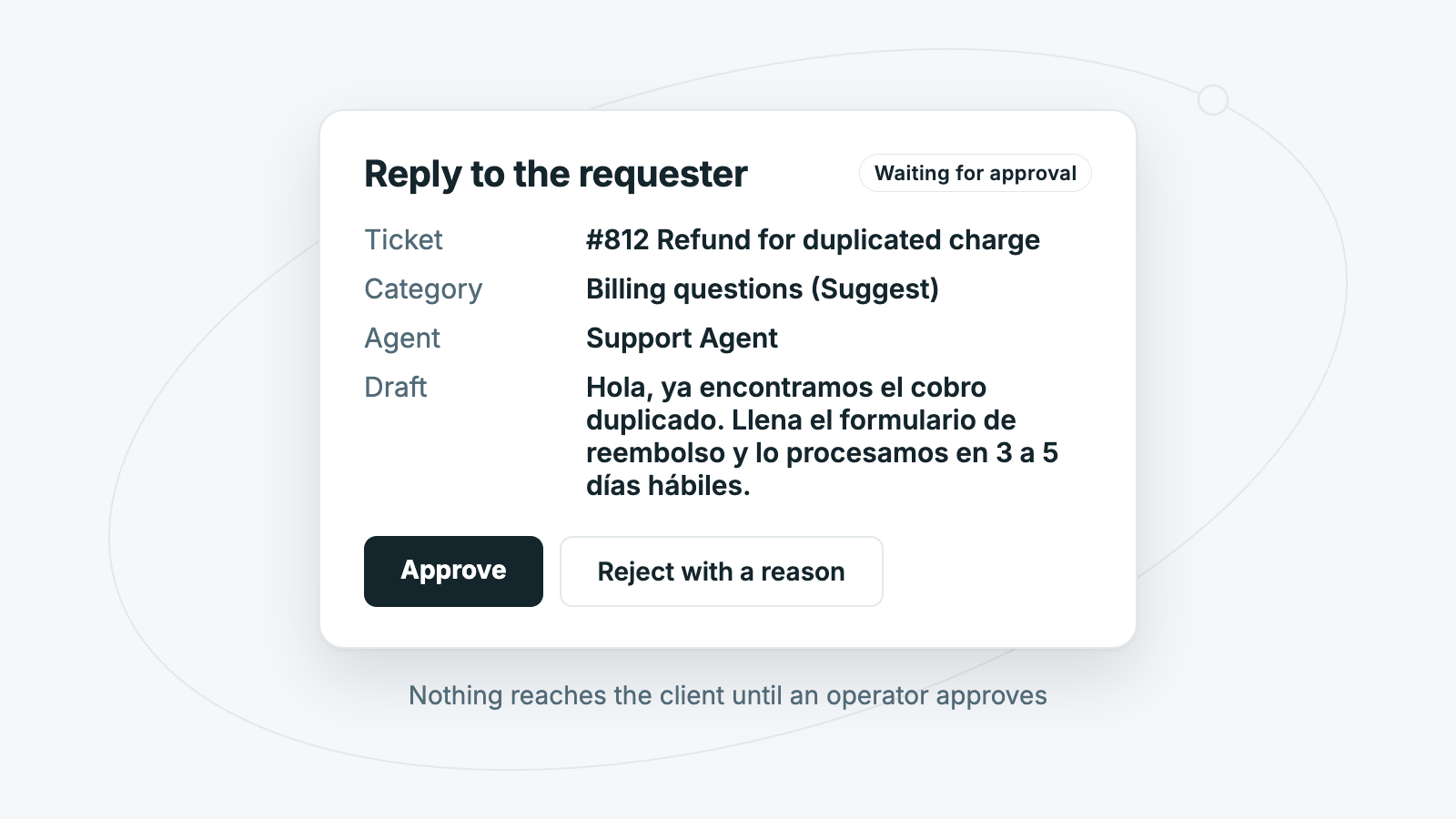
Suggest only works if operators actually review what the agent proposes, so rejecting a draft has to be quick and useful. An operator rejects with a reason. The agent drafts again with that reason in front of it, as many times as needed.
We dropped two ideas that sounded good on paper. The first was letting operators edit a draft before approving it. That means building an editor for every tool’s arguments. The audit trail would also end up mixing human and agent authorship in a single action. The second was handing the ticket off automatically after three rejections in a row. A counter like that makes sense when an agent can loop without a human in the middle, but in Suggest there’s always a human in the middle. They can take over whenever they want. A daily cap on turns already stops an agent that’s going in circles.
A detail we like here is that the rule “no draft reaches the client before approval” holds by construction. TrueTicket emails every public comment to the client right after it’s saved. A draft never becomes a comment until the approved call runs, so before approval there’s simply nothing to send. Drafts also go stale on their own. A new message from the client supersedes a pending client-facing draft. One that nobody answers expires after 24 hours by default.
A person can always take the ticket back
Any operator will be able to take over a ticket at any moment. The takeover wins even if the agent is halfway through something. It happens in one transaction that sets the ticket to Manual, marks it as owned by a human, assigns it to the operator, withdraws pending suggestions and cancels queued work. There’s still a small race to cover. An Autopilot write might have been approved a few hundred milliseconds before the takeover, with the agent’s request still on its way. The policy check catches that case too, because it refuses any bot write on a ticket a human owns, so the takeover wins regardless of timing.
If an operator starts typing a client-visible reply on a ticket the agent owns, the composer asks them to take over first. A client should never get answers from two voices on the same ticket.
Handing back is the agent’s side of the same idea. Requesting a handoff is a gated tool like any other, so TrueTicket always knows when one is coming. The ticket goes back to its resolver group’s queue, flagged with the agent’s reason. The agent’s summary (what the client needs and what it already did, plus anything still open) is posted as an internal comment. The group also gets an email. Trying to act outside its scope ends in a handoff too, with its own reason.
Limits that stop the agent before it spends
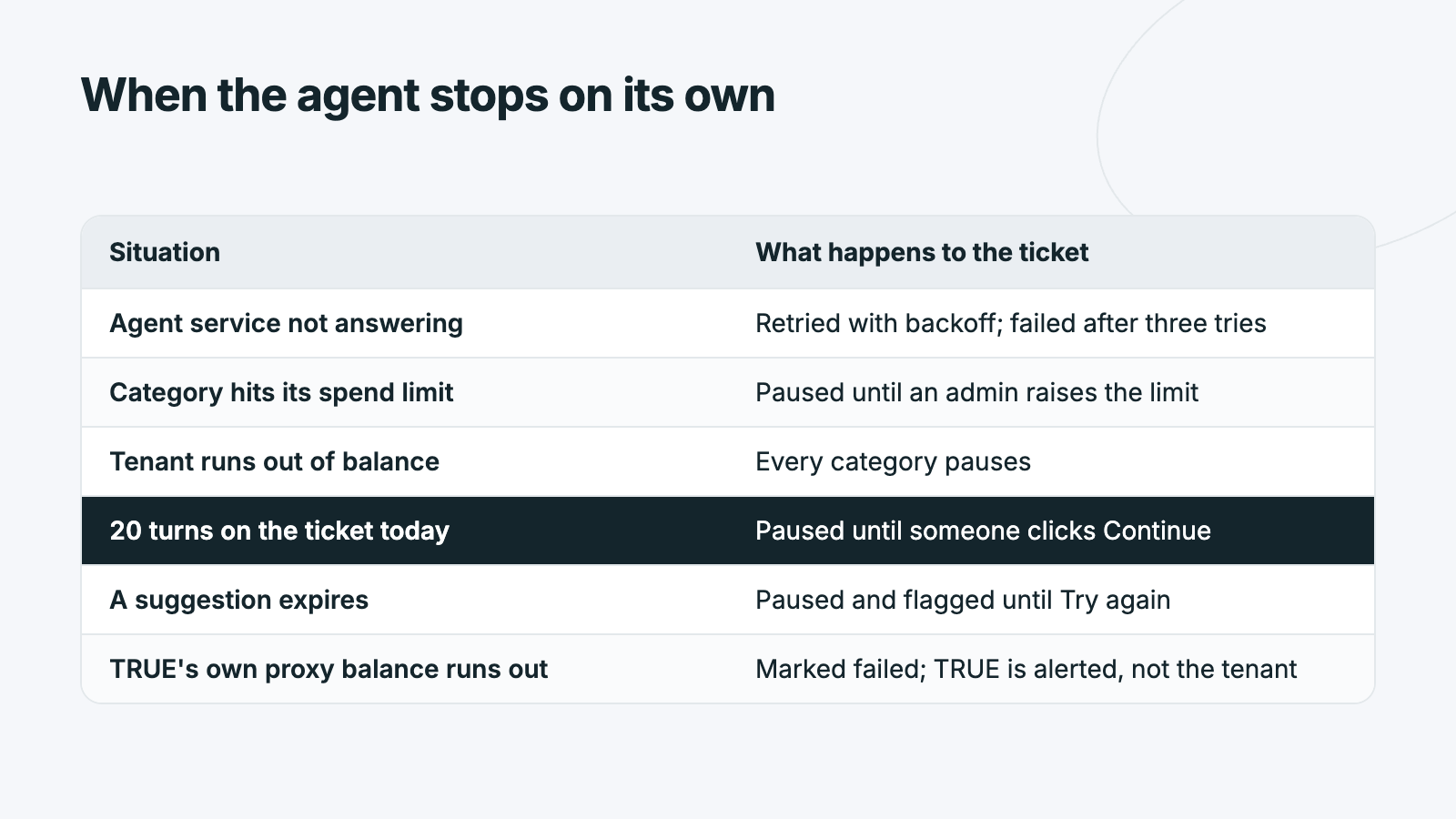
An agent working alone needs limits that don’t depend on anyone watching. Each category will have a spend limit. The tenant will have a balance shared by all its agents. Both are checked before every turn starts, never halfway through one, so a running turn finishes its current step. Crossing 80% of a limit sends a warning email and nothing more.
When something does stop the agent, the ticket says why:
An audit trail that says who did what
Every change to a ticket will carry one of three labels. Either the agent acted on its own, the agent suggested and a person approved it or a person did it directly. Suggestions that never ran (rejected, superseded, expired or withdrawn) are logged as well, so the history shows them without counting them as changes. The agent writes through the same endpoints a human uses, which means the existing notifications and field-level audit keep working with the bot as the actor.
Those labels are also what a manager will use to decide when a category is ready to graduate from Suggest to Autopilot. We’ll record them from the start, but we plan to build the per-category dashboard only after a pilot tenant has used Suggest and Autopilot for a few weeks. That way it shows the numbers that actually tell a team the agent is earning its autonomy, rather than the numbers we’d guess today.