TRUE Agents
AI agents that work inside your systems and ask before they act.
We design, build and run agents for one job at a time. They read your data, draft the work and act through your tools. When an action matters, someone on your team confirms it first, and every step is logged.
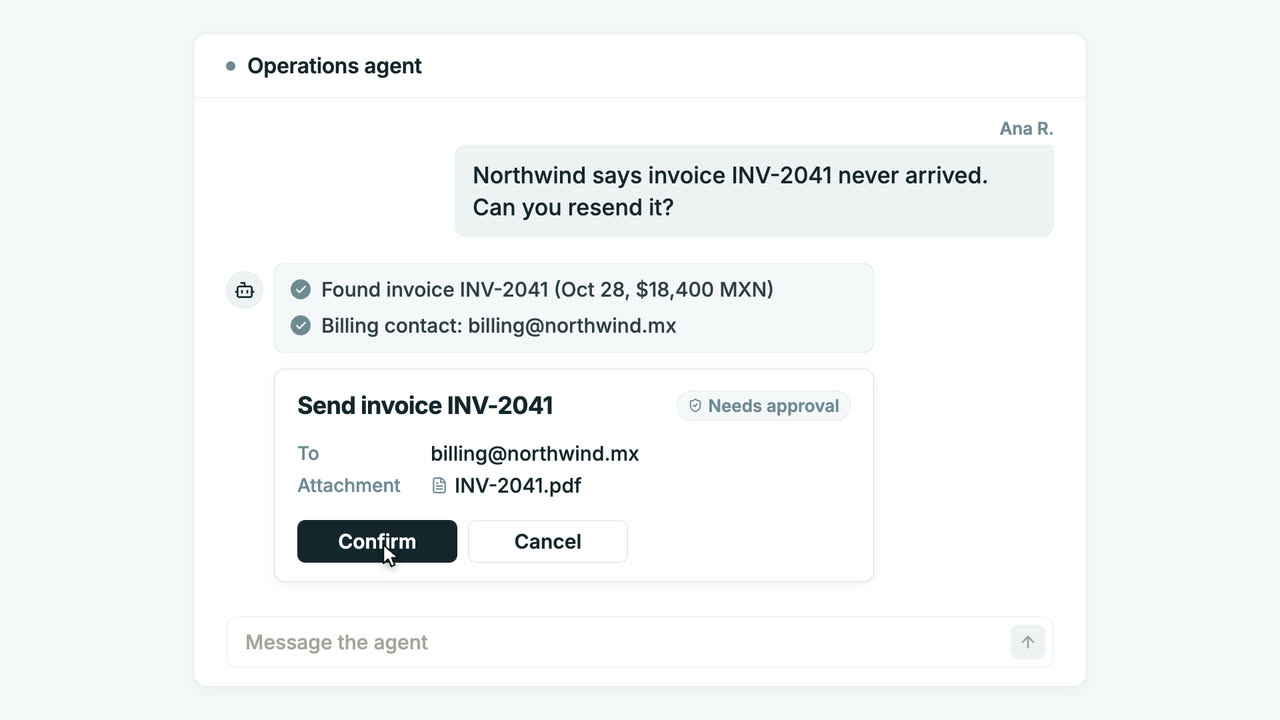
Where our agents work
The same agent can live in our console, inside your product or behind the scenes with no chat at all.
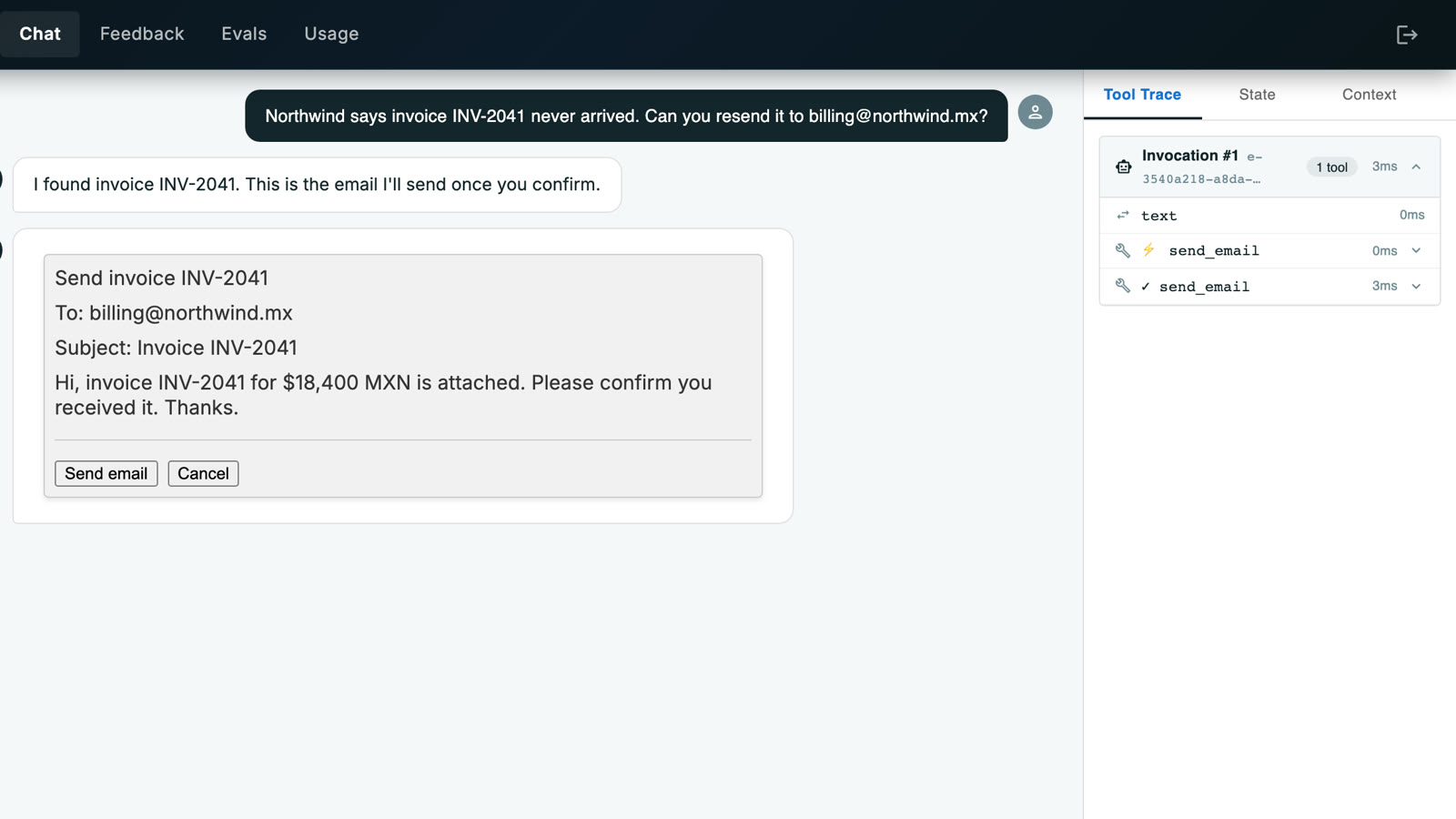
TRUE Agentic Platform
Agents built on TRUE ADK come with our console. Your team can chat with the agent, follow every tool call in the trace, review what users rated, run eval sets and track usage.
Where an agent helps
Agents pay off on work that happens often, follows rules and touches several systems. We start with one job and grow from there.
Answer questions from your data
People ask in plain language and the agent answers with read-only queries against your database, showing what it looked up.
Work tickets and requests
The agent reads the request, gathers context, drafts the reply and proposes the next step for someone to approve.
Answer from your documents
Policies, contracts and manuals turn into answers that cite the page they came from.
Run back-office steps
Look up a record, generate a PDF, send an email or start a workflow, with a confirmation before anything goes out.
Agents we run today
Clients are described by industry.
Health and nutrition app, Mexico
In productionA coaching agent inside a nutrition app
Users tell the agent what they ate, in Spanish and in their own words. It logs the meal, plans the day or the week and tracks macros. A calculation engine does the math so the numbers stay exact, and the user confirms each change before it’s saved.
Lead generation call center, United States
In productionAI review of every sales call
Each recorded call is transcribed with speaker separation, checked against the campaign’s qualification rules and screened for compliance issues, so reviewers start with the calls that need them.
ERP software vendor
PilotPlain-language questions over business data
The vendor’s customers ask about their own sales, inventory and accounts. The agent answers with read-only queries against each customer’s own database.
How we build an agent
- 1
Pick one job
We sit with the people who do the work today, choose one process and write down what the agent may do alone and what needs approval.
- 2
Connect and test
We build the agent on TRUE ADK, our own framework, connect it to your systems and test it against real cases before anyone relies on it.
- 3
Launch with a person in the loop
Actions that matter go through confirmation cards. Every message and tool call is visible in an admin console, and users rate each answer.
- 4
Run and improve
We watch feedback and usage, add every failure to the test set and adjust prompts, tools or the model.
You decide what the agent can do
Approval before high-stakes actions
Sensitive tools pause the agent and show a confirmation card with the exact details. Nothing runs until someone clicks Confirm.
Read-only where possible
Database access is read-only by default, and each agent gets the tools for its job and nothing else.
A record of every step
Messages, tool calls and confirmations are kept per session and can be reviewed in the admin console.
Any major model
Agents run on OpenAI, Anthropic or Google models through our gateway, so we can switch when a better or cheaper one appears.
Costs you can see
Every model call is metered, so you know what each conversation costs.
Our cloud or yours
Agents ship as containers. We run them for you or deploy them in your infrastructure.
TRUE Agents in TrueTicket
Soon you’ll assign an agent to a ticket category the same way you assign a person, and choose how closely to supervise it.
Manual
Acts only when someone mentions it on a ticket.
Suggest
Drafts replies and actions, and a person approves or rejects each one.
Autopilot
Works tickets on its own within the scope you grant and hands off when it should.
You can take over with one click, set spending limits and see every action in the ticket history.
Common questions
Which AI models do you use?
Models from OpenAI, Anthropic and Google, chosen per task. They run through our own gateway, which lets us change models without rebuilding the agent.
Can an agent act without approval?
Only where you allow it. Each tool is set as automatic or as needing confirmation, and we start conservative.
What data does the agent see?
Only what its tools expose. We prefer read-only access and connect each system on purpose.
Which languages do the agents speak?
Spanish and English. We set the language per agent or let it reply in the language the user writes in.
How do we start?
With a 30-minute call. We pick one process and tell you whether an agent is the right tool or whether a simpler automation would do the job.
Start with one process
Tell us which work repeats every day. We’ll tell you plainly whether an agent fits and what a first version would look like.